Curb ramps are one of the most litigated elements of ADA compliance in the public right-of-way. Missing, poorly designed, or non-compliant curb ramps can prevent people with disabilities from safely crossing streets and expose public agencies to immediate legal risk.
We help cities, counties, and public agencies identify, assess, and prioritize curb ramp improvements through comprehensive ADA curb ramp inventories and compliance plans.
How We Perform ADA Curb Ramp Surveys
Our team performs intersection-by-intersection field inspections of curb ramps using standardized ADA and PROWAG criteria. Each curb ramp is evaluated individually, including perpendicular, parallel, blended transitions, and directional ramps.
We collect detailed data on:
- Presence or absence of curb ramps
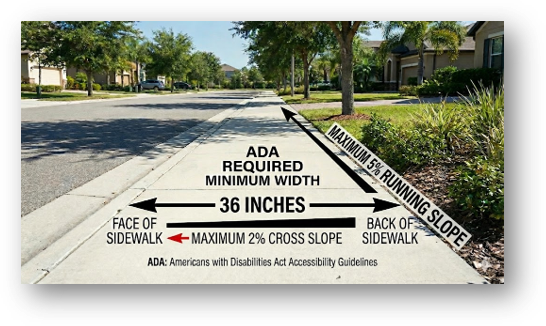
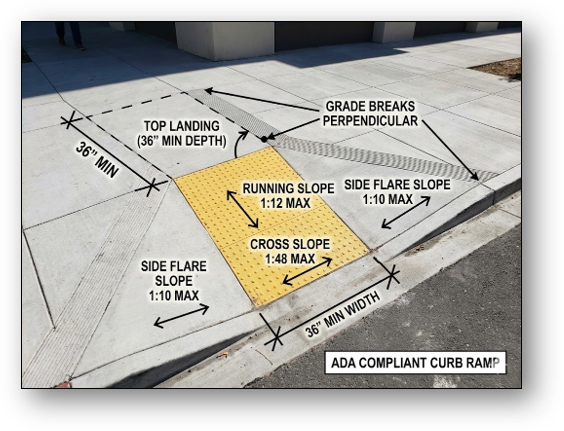
- Running slope and cross slope
- Landing size and slope
- Flare slopes and transitions
- Alignment with crosswalks
- Detectable warning surfaces (size, placement, contrast)
- Vertical lips, gaps, and construction defects
All curb ramp data is GPS-located, photo-documented, and mapped in GIS, creating a defensible inventory that agencies can use for compliance tracking and capital planning.
From Inventory to Actionable Curb Ramp Programs
Using the field data, we develop curb ramp compliance programs that include:
- Identification of non-compliant and missing curb ramps
- ADA risk classification and prioritization
- Planning-level construction cost estimates
- Phased retrofit schedules aligned with resurfacing and CIP projects
- Integration with pavement rehabilitation and street improvement programs
This approach allows agencies to fix curb ramps strategically, rather than reacting to complaints or lawsuits.
Why Curb Ramps Are a High-Risk ADA Issue
Under the ADA, curb ramps are required wherever pedestrian walkways intersect streets. Agencies that fail to provide compliant curb ramps are frequently subject to complaints, lawsuits, and enforcement actions by the U.S. Department of Justice.
Common triggers for enforcement include:
- Street resurfacing or reconstruction without curb ramp upgrades
- Missing curb ramps at existing intersections
- Curb ramps that do not meet slope or landing requirements
- Misaligned ramps that direct users into traffic
Once a complaint is filed, agencies often lose control over scope, schedule, and cost.
Designed for Real-World Public Agency Constraints
Our curb ramp programs are designed to work within:
- Limited budgets and staffing
- Capital Improvement Programs (CIPs)
- Pavement management and resurfacing schedules
- Grant funding and reporting requirements
By coordinating curb ramp upgrades with roadway projects, agencies can achieve ADA compliance faster and at a lower cost.
The Bottom Line
Curb ramps are not just a design detail, they are a core ADA compliance requirement and a major source of liability for public agencies.
Our curb ramp inventories and compliance plans give agencies the data, prioritization, and documentation needed to:
- Reduce legal exposure
- Plan improvements proactively
- Demonstrate good-faith ADA compliance
- Provide safe and accessible crossings for all users