
Sidewalk Asset Management and ADA Transition Planning
Building Accessible Communities Through Data Driven Infrastructure Management
A White Paper by Civil Infrastructure Solutions (CIS)
Executive Summary
Sidewalks are among the most heavily used public assets, yet they remain one of the least managed.
Unlike pavements, sidewalks are not simply transportation infrastructure. They provide access to schools, businesses, transit stops, parks, hospitals, and government facilities. For millions of Americans, including individuals with disabilities, sidewalks determine whether a community is truly accessible.
The Americans with Disabilities Act (ADA) requires public agencies to ensure that pedestrian facilities are accessible to all users. This responsibility extends beyond new construction and includes maintaining existing sidewalks, curb ramps, pedestrian routes, and crossings.
Many agencies have completed sidewalk inventories or ADA assessments. However, far fewer possess an integrated system that transforms this information into actionable maintenance plans, budget forecasts, and ADA Transition Plans.
This paper explores how modern Sidewalk Asset Management and ADA compliance should work together within a unified Enterprise Asset Management platform.
Sidewalks Are Critical Infrastructure
Roads move vehicles.
Sidewalks move people.
For many residents, particularly seniors, children, and individuals with disabilities, sidewalks are the primary transportation network.
A sidewalk network includes far more than concrete panels.
It includes:
- Sidewalk segments
- Curb ramps
- Detectable warning surfaces
- Crosswalks
- Pedestrian signals
- Driveway crossings
- Pedestrian refuge islands
- Accessible parking connections
- Transit stop access routes
Each component contributes to an accessible pedestrian network.
Understanding ADA Compliance
The Americans with Disabilities Act (ADA), together with the Public Right of Way Accessibility Guidelines (PROWAG), establishes accessibility requirements for public infrastructure.
Agencies are responsible for identifying barriers and developing plans to remove them over time.
Common accessibility deficiencies include:
- Missing curb ramps
- Excessive cross slope
- Excessive running slope
- Vertical displacement
- Damaged pavement
- Obstructions within the pedestrian access route
- Missing detectable warnings
- Insufficient sidewalk width
- Utility poles blocking access
- Inaccessible driveway crossings
Compliance is not simply a matter of meeting regulations.
It is about providing equal access for every member of the community.
The Challenge Facing Public Agencies
Most agencies manage thousands of sidewalk assets.
These assets age continuously.
Tree roots lift concrete.
Weather creates cracks.
Utilities disturb pedestrian routes.
Budgets remain limited.
As a result, agencies face difficult questions.
- Which sidewalk should be repaired first?
- Which ADA barriers present the greatest risk?
- Which projects provide the greatest public benefit?
- How much funding is needed over the next ten years?
- Which neighborhoods should receive priority?
Answering these questions requires more than an inventory.
It requires Sidewalk Asset Management.
What Is Sidewalk Asset Management?
Sidewalk Asset Management is the systematic process of:
- Inventorying sidewalk assets
- Inspecting condition
- Evaluating accessibility
- Prioritizing repairs
- Estimating costs
- Planning investments
- Tracking completed work
- Monitoring long term performance
Rather than reacting to complaints, agencies proactively manage their pedestrian infrastructure.
The Role of an ADA Transition Plan
An ADA Transition Plan is more than a regulatory document.
It is a long term investment strategy.
A modern Transition Plan should answer five questions.
1. What assets do we own?
Every sidewalk, curb ramp, and pedestrian facility should be inventoried.
2. What barriers exist?
Each asset should be inspected for:
- Physical condition
- Accessibility deficiencies
- Safety concerns
- ADA compliance
3. Which barriers should be addressed first?
Not every deficiency carries the same level of risk.
Priority may depend on:
- Schools
- Hospitals
- Transit stops
- Government facilities
- Pedestrian volume
- Safety
- Legal exposure
4. What will it cost?
Every improvement should include estimated construction costs.
This enables agencies to develop realistic funding strategies.
5. How long will implementation take?
Most ADA Transition Plans span:
- 5 years
- 10 years
- 20 years
The plan should balance available funding with accessibility goals.
Why Condition Alone Is Not Enough
A sidewalk may be in excellent physical condition yet still violate accessibility requirements.
For example:
A newly constructed sidewalk may have:
- Excellent surface condition
- No cracking
- No settlement
However, if the cross slope exceeds ADA limits, it remains non compliant.
Likewise, a sidewalk with moderate cracking may still be fully accessible.
Condition and accessibility are related but different.
Both must be evaluated independently.
Beyond Sidewalk Ratings
Many agencies assign a simple sidewalk condition score.
While useful, a single score cannot describe accessibility.
Modern sidewalk management evaluates multiple characteristics, including:
- Surface condition
- Cross slope
- Running slope
- Vertical displacement
- Width
- ADA compliance
- Trip hazards
- Obstructions
- Pedestrian connectivity
- Curb ramp compliance
These attributes provide a more complete understanding of the pedestrian network.
GIS Driven Sidewalk Management
Maps provide the foundation of modern sidewalk management.
GIS enables agencies to visualize:
- Sidewalk condition
- ADA deficiencies
- Missing curb ramps
- Inspection history
- Citizen requests
- Planned improvements
- Active work orders
- Completed repairs
Rather than searching through spreadsheets, decision makers immediately understand where investments are needed.
Prioritization Versus Optimization
Many agencies prioritize projects using a simple ranking.
Highest priority first.
While useful, prioritization alone does not maximize network performance.
Optimization considers:
- Budget constraints
- Risk
- Accessibility
- Engineering priorities
- Geographic equity
- Project costs
The objective is to maximize accessibility improvements using limited funding.
Decision Trees for Sidewalk Management
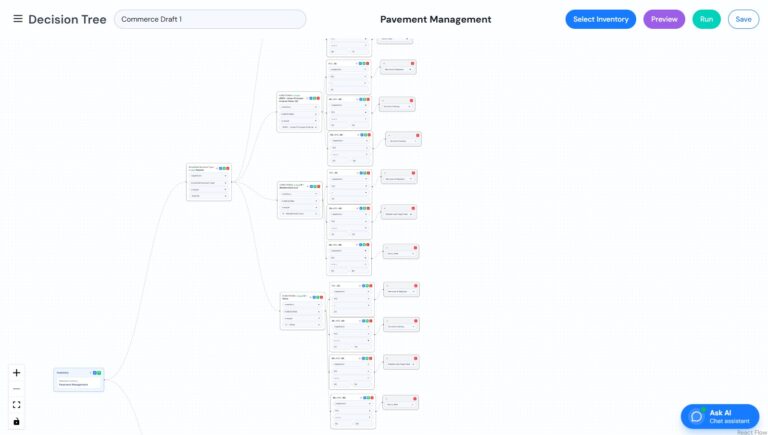
Just as pavement management relies on decision trees, sidewalk management should use engineering rules.
For example:
If:
- Vertical displacement exceeds agency threshold
↓
Recommend sidewalk grinding.
If:
- Cross slope exceeds accessibility standards
↓
Recommend panel replacement.
If:
- Detectable warnings are missing
↓
Recommend curb ramp upgrade.
These rules ensure consistency across the entire sidewalk network.
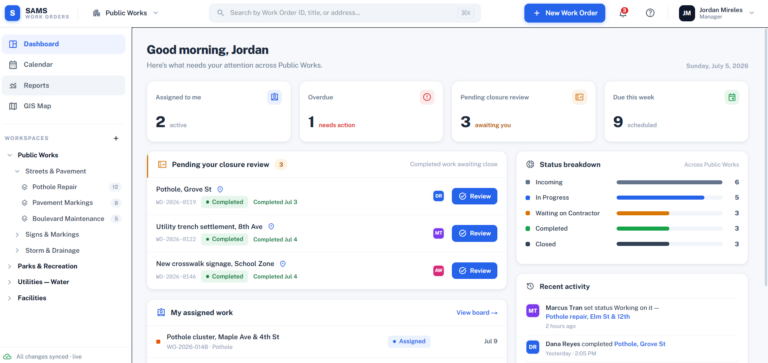
Work Order Integration
Planning alone does not improve accessibility.
Maintenance crews must execute the work.
A modern system connects:
Inspection
↓
ADA Deficiency
↓
Recommended Repair
↓
Work Order
↓
Construction
↓
Updated Asset History
Every completed repair automatically updates the sidewalk inventory.
Citizen Requests
Many sidewalk repairs begin with citizen complaints.
Examples include:
- Trip hazards
- Damaged sidewalks
- Missing curb ramps
- Blocked sidewalks
- Standing water
When integrated with asset management, citizen requests become part of the engineering workflow instead of isolated service tickets.
Mobile Data Collection
Modern sidewalk inventories no longer rely exclusively on clipboards.
Today’s technologies include:
- Mobile GIS
- GPS enabled tablets
- High resolution imagery
- Artificial Intelligence
- Mobile mapping
- LiDAR
- Automated feature extraction
These technologies improve data quality while reducing collection time.
Why Historical Data Matters
Every repair becomes valuable engineering information.
Historical records reveal:
- Failure patterns
- Maintenance frequency
- Construction quality
- Contractor performance
- Lifecycle costs
- Accessibility improvements
This information supports better long term planning.
Sidewalk Management in SAMS
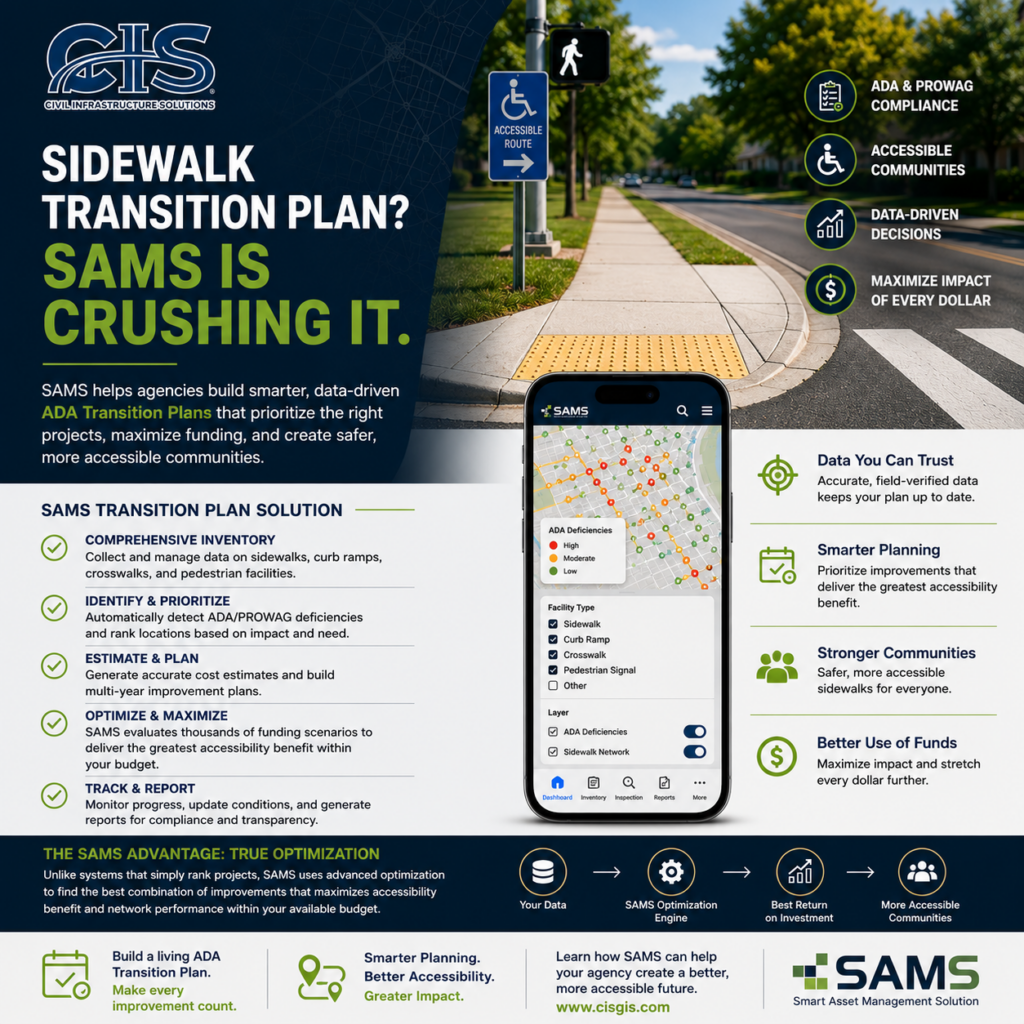
SAMS provides a unified platform for managing pedestrian infrastructure.
Within SAMS, agencies can:
- Inventory sidewalks and curb ramps.
- Record ADA compliance attributes.
- Store inspection data and photographs.
- Identify accessibility deficiencies.
- Develop ADA Transition Plans.
- Prioritize improvements.
- Optimize investments.
- Generate work orders.
- Track completed repairs.
- Monitor compliance progress through GIS dashboards and executive reports.
Rather than managing multiple disconnected spreadsheets and databases, agencies gain a single source of truth for their pedestrian infrastructure.
The Future of Accessible Infrastructure
Communities are becoming more connected, more walkable, and more inclusive.
Infrastructure management must evolve accordingly.
The future combines:
- GIS
- Mobile inspections
- Artificial Intelligence
- LiDAR
- Predictive analytics
- Decision trees
- Optimization
- Work Order Management
- ADA compliance
into one intelligent platform.
Accessibility should not be treated as a separate initiative.
It should be integrated into everyday asset management.
Conclusion
ADA compliance is not simply about meeting regulatory requirements.
It is about ensuring that every resident can safely and independently navigate the public right of way.
A successful ADA Transition Plan requires more than inspections and inventories.
It requires a complete asset management strategy that connects condition assessments, accessibility evaluations, budgeting, prioritization, work order management, and long term planning.
By integrating these functions into a single Enterprise Asset Management platform, agencies can move beyond compliance and build safer, more accessible, and more resilient communities.
About Civil Infrastructure Solutions (CIS)
Civil Infrastructure Solutions (CIS) develops SAMS, a GIS centric Enterprise Asset Management platform that unifies sidewalk management, ADA Transition Planning, pavement management, work order management, inspections, decision trees, optimization, and mobile field operations into a single intuitive solution for public agencies.