
The Foundation of Consistent, Data Driven Maintenance Decisions
Author: Civil Infrastructure Solutions (CIS)
Executive Summary
Every pavement management system can calculate a Pavement Condition Index (PCI), estimate deterioration, and rank projects. However, the quality of the recommendations depends entirely on one question:
How does the software decide which treatment to recommend?
The answer lies in the Decision Tree.
Decision trees are the engineering intelligence behind every pavement management system. They translate decades of pavement engineering experience into repeatable, transparent, and defensible maintenance recommendations.
Unfortunately, many agencies still rely on simplistic PCI thresholds or subjective engineering judgment, resulting in inconsistent treatment selection and reduced return on investment.
This paper explains what decision trees are, why they are essential to modern pavement management, and how configurable decision trees enable agencies to maximize the life of their transportation assets.
Introduction
Pavement management is not about finding the worst roads.
It is about determining
- the right treatment,
- for the right pavement,
- at the right time,
- within the available budget.
Making these decisions consistently across thousands of road segments is impossible without a structured decision making framework.
That framework is called a Decision Tree.
What Is a Decision Tree?
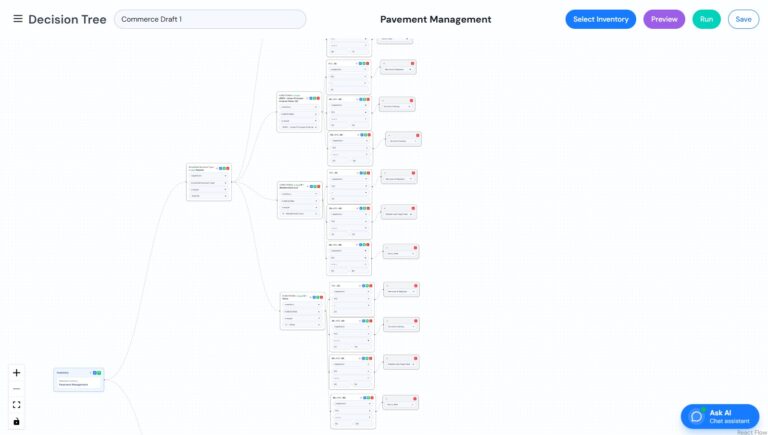
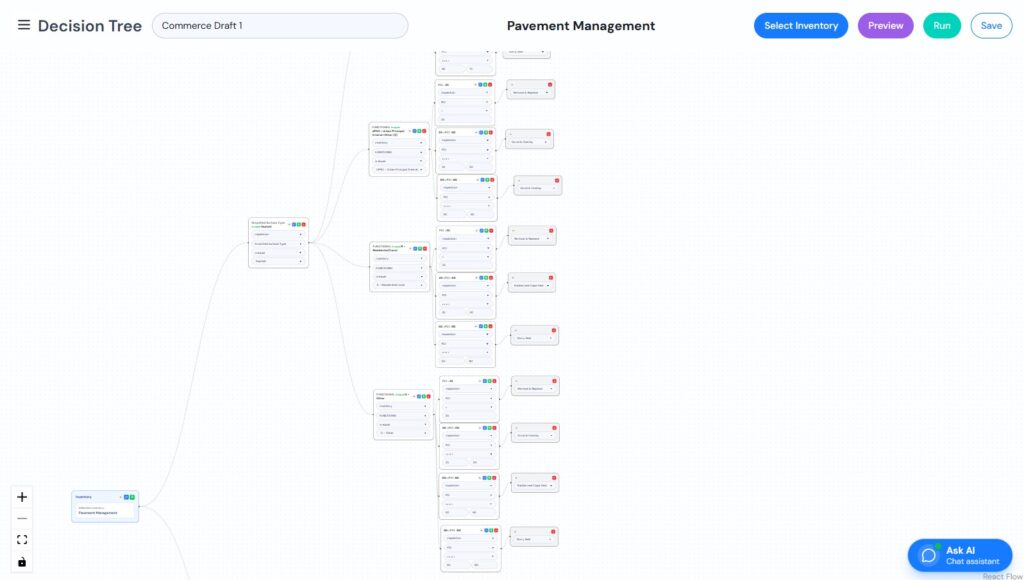
A decision tree is a collection of engineering rules that determine the most appropriate maintenance or rehabilitation treatment for each pavement segment.
Rather than relying on a single pavement score such as PCI, decision trees evaluate multiple factors simultaneously.
These may include
- PCI
- Individual distress quantities
- Rutting
- Alligator cracking
- Longitudinal cracking
- Ride quality (IRI)
- Functional classification
- Traffic volume
- Pavement age
- Last treatment date
- Surface type
- Structural capacity
- Remaining service life
- Agency priorities
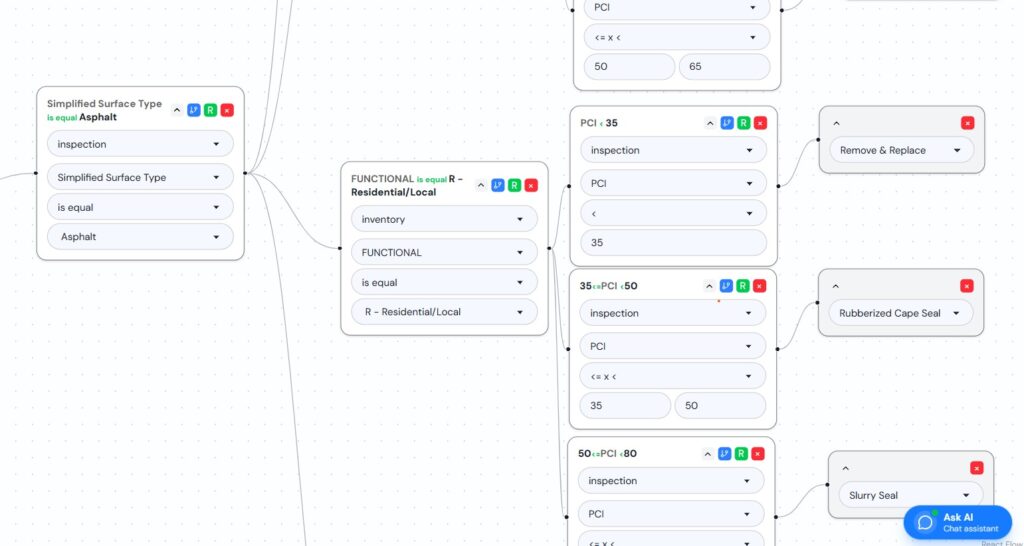
Each branch of the tree represents an engineering decision.
For example,
PCI > 85

↓

Do Nothing

-------------------

PCI 70–85

↓

Crack Seal

-------------------

PCI 55–70

↓

Slurry Seal

-------------------

PCI 40–55

↓

Mill & Overlay

-------------------

PCI < 40

↓

Reconstruction
While this example is simple, modern decision trees can contain hundreds of engineering rules.
Why PCI Alone Is Not Enough
Many agencies still select treatments based solely on PCI.
For example
| PCI | Treatment |
|---|---|
| 85–100 | None |
| 70–85 | Crack Seal |
| 55–70 | Slurry Seal |
| Below 55 | Overlay |
Although easy to understand, this approach ignores many important engineering factors.
Two pavements may both have a PCI of 60.
One may have
- moderate transverse cracking
- excellent ride quality
- little structural distress
The other may exhibit
- severe fatigue cracking
- rutting
- poor drainage
- structural failure
Despite having identical PCI values, the appropriate treatment is completely different.
Decision trees solve this problem.
Engineering Knowledge Becomes Repeatable
One of the biggest challenges facing transportation agencies is preserving institutional knowledge.
Senior pavement engineers retire.
Consultants change.
Policies evolve.
Without documented engineering logic, maintenance decisions become inconsistent.
Decision trees preserve agency knowledge by documenting engineering practices in a transparent and repeatable format.
Every recommendation can be traced back to a defined engineering rule.
The Benefits of Decision Trees
Consistency
Every pavement segment is evaluated using identical engineering criteria.
No subjective judgment.
No inconsistent recommendations.
Transparency
Unlike black box algorithms, decision trees clearly explain why a treatment was selected.
This builds confidence among
- City Engineers
- Public Works Directors
- Finance Departments
- City Councils
Flexibility
Every agency is different.
Some prioritize
- preserving residential streets
Others prioritize
- arterial corridors
Others focus on
- minimizing maintenance costs
Decision trees can easily reflect these priorities.
Scalability
Whether managing
- 50 lane miles
- 500 lane miles
- 5,000 lane miles
the same engineering logic can be applied consistently across the entire network.
Decision Trees vs Ranking
Many pavement management systems simply rank roads from worst to best.
Ranking answers
Which roads are in the worst condition?
Decision trees answer
What is the appropriate treatment for each road?
These are fundamentally different questions.
Treatment selection should always occur before project prioritization.
Decision Trees and Network Optimization
Decision trees determine
What should be done.
Optimization determines
When it should be done.
These are complementary processes.
For example,
Decision Tree
↓
Micro Surface
↓
Optimization Engine
↓
Delay treatment one year
↓
Increase overall network PCI by 3 points
Without decision trees, optimization has no engineering foundation.
Without optimization, decision trees cannot maximize network performance.
Modern pavement management requires both.
Decision Trees in SAMS
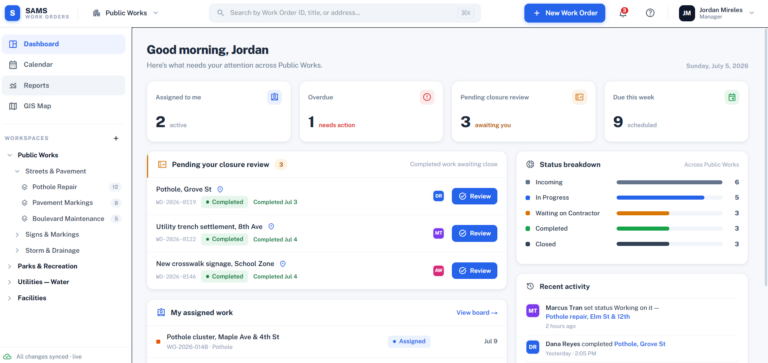
SAMS was designed around configurable decision trees.
Rather than forcing agencies to adopt predefined engineering logic, SAMS allows users to build decision trees that reflect their own policies and standards.
Decision trees can incorporate
- PCI
- Distress quantities
- Traffic levels
- Functional classification
- Pavement age
- Surface type
- Previous maintenance
- Budget constraints
- Any custom attribute stored within the asset database
Changes can be made without software development or programming.
This allows agencies to continuously refine maintenance strategies as engineering practices evolve.
Beyond Pavement
The same decision tree framework can also support other public assets including
- Sidewalks
- Signs
- Pavement markings
- ADA curb ramps
- Stormwater assets
- Parks
- Bridges
Each asset type follows its own engineering rules while using the same analytical framework.
The Future of Decision Trees
Artificial Intelligence is changing how pavement distress is collected.
LiDAR is changing how road profiles are measured.
Mobile mapping is changing data collection.
However, engineering decisions still require structured logic.
Decision trees remain the bridge between condition data and actionable maintenance recommendations.
As agencies move toward predictive asset management, decision trees will become even more important because they provide explainable, transparent engineering decisions that can be validated, audited, and continuously improved.
Conclusion
Decision trees are much more than flowcharts.
They represent decades of pavement engineering expertise transformed into a repeatable decision making framework.
When combined with reliable condition data, deterioration modeling, and network optimization, decision trees enable agencies to
- extend pavement life
- maximize return on investment
- improve network condition
- justify funding decisions
- preserve institutional knowledge
- deliver consistent engineering recommendations
Modern pavement management is no longer about simply ranking roads.
It is about making the right engineering decision at the right time.
Decision trees make that possible.
About Civil Infrastructure Solutions (CIS)
Civil Infrastructure Solutions (CIS) develops SAMS, a modern Enterprise Asset Management platform that combines GIS, pavement management, configurable decision trees, advanced optimization, work order management, and infrastructure analytics into a single, intuitive solution for public agencies.