
Why the Future of Infrastructure Management Depends on Connecting Planning with Execution
A White Paper by Civil Infrastructure Solutions (CIS)
Executive Summary
For decades, public agencies have invested in Pavement Management Systems (PMS) to determine what maintenance should be performed and when it should occur. At the same time, many agencies have implemented separate Work Order Management (WOM) systems to track maintenance activities.
Unfortunately, these systems often operate independently.
The result is a disconnected workflow where engineers develop maintenance plans in one application while maintenance crews execute work in another. This separation leads to duplicate data entry, outdated inventories, inconsistent records, and missed opportunities to improve future decision making.
A modern Enterprise Asset Management (EAM) platform should eliminate this disconnect.
Work Order Management should not be a standalone application. It should be an integral component of the asset management lifecycle, directly connected to inventories, inspections, pavement management, budgeting, and capital planning.
This paper explores why integration matters and how connected systems enable agencies to move from planning to execution and back again, creating a continuous cycle of data driven asset management.
The Missing Link in Asset Management
Most agencies already know what assets they own.
Many know their condition.
Some know what treatments should be performed.
Far fewer have a system that ensures those recommendations become completed work while automatically updating the asset database.
This missing connection creates a gap between engineering decisions and field operations.
Without integration, agencies lose visibility into:
- Which recommended projects were completed
- Which treatments were delayed
- Actual maintenance costs
- Crew productivity
- Material usage
- Historical maintenance records
- Updated asset condition
The result is fragmented information and inefficient decision making.
The Asset Management Lifecycle
Infrastructure management should not be viewed as separate software modules.
It is one continuous process.
Inventory → Inspection → Analysis → Planning → Work Orders → Field Execution → Work History → Reinspection → Optimization
Every step depends on the previous one.
When Work Order Management is disconnected, this lifecycle is broken.
From “What Should We Do?” to “What Did We Do?”
A Pavement Management System answers questions such as:
- Which roads require maintenance?
- Which treatment provides the highest return on investment?
- What projects fit within this year’s budget?
- How will the network perform over the next ten years?
A Work Order Management System answers different questions:
- Who will perform the work?
- When will it be completed?
- What materials are required?
- What equipment is needed?
- What was the actual cost?
- Has the work been completed?
Both systems are essential.
Neither is complete without the other.
Why Integration Matters
Imagine a pavement segment identified for crack sealing.
The pavement management system recommends treatment.
Without integration:
- An engineer manually creates a work order.
- Maintenance staff complete the work.
- Another employee updates the pavement database.
- Budget records are entered into another system.
- Work history is stored somewhere else.
The same information is entered multiple times.
Now consider an integrated platform.
The pavement recommendation automatically becomes a work order.
The work order is assigned to a maintenance crew.
Field staff update progress using a mobile device.
When completed:
- The work history is automatically recorded.
- The asset inventory is updated.
- The treatment date is stored.
- Costs are tracked.
- Future deterioration models are updated.
- Future analyses use the latest information.
No duplicate data entry.
No disconnected databases.
One source of truth.
The Closed Loop Asset Management Process
Modern asset management should operate as a closed loop.
- Inspect assets.
- Evaluate condition.
- Recommend treatments.
- Prioritize projects.
- Generate work orders.
- Execute maintenance.
- Record completed work.
- Update asset history.
- Reevaluate network performance.
Every completed work order improves the quality of future engineering decisions.
Beyond Pavement
Work Order Management should extend beyond roads.
Public agencies maintain thousands of assets, including:
- Sidewalks
- ADA curb ramps
- Traffic signs
- Pavement markings
- Guardrails
- Streetlights
- Drainage systems
- Parks
- Buildings
- Fleet assets
Regardless of asset type, the workflow remains the same.
Inspect.
Plan.
Assign.
Complete.
Document.
Analyze.
GIS as the Operational Hub
Maps are more than visualization tools.
They are operational dashboards.
When Work Order Management is integrated with GIS, agencies can:
- View active work orders on a map.
- Identify nearby maintenance requests.
- Optimize crew routing.
- Track completed work geographically.
- Filter work by status or priority.
- Monitor citywide operations in real time.
Instead of switching between mapping software and maintenance software, users work from a single interface.
Data Driven Maintenance
Integrated Work Order Management transforms maintenance records into engineering knowledge.
Historical work orders reveal:
- Treatment frequency
- Asset performance
- Maintenance costs
- Crew productivity
- Material consumption
- Contractor performance
- Asset lifecycle trends
This information strengthens future planning and budgeting.
Maintenance history becomes one of the most valuable datasets in the organization.
Budget Accountability
Public agencies must justify every dollar spent.
An integrated system connects:
- Planned budgets
- Approved projects
- Work orders
- Labor costs
- Material costs
- Equipment usage
- Final expenditures
Decision makers can compare planned versus actual costs and improve future budget estimates.
Citizen Requests and Service Requests
Many maintenance activities begin with a citizen report.
Examples include:
- Potholes
- Missing signs
- Sidewalk hazards
- Faded pavement markings
- Drainage problems
Rather than existing in a separate customer service application, these requests should be linked directly to:
- The affected asset
- Its inspection history
- Existing work orders
- Planned maintenance
- Responsible staff
This eliminates duplicate requests and improves response times.
Mobility Changes Everything
Field crews should not return to the office to update maintenance records.
Modern Work Order Management enables crews to:
- Receive assignments in the field
- Navigate to asset locations
- View inspection photos
- Upload new photographs
- Record labor and materials
- Update work status
- Close work orders immediately
The office receives updates in real time.
Work History is Engineering Data
Every completed work order contributes to better pavement management.
For example:
A road received:
- Crack sealing in 2021
- Slurry seal in 2024
Future deterioration models should recognize these treatments.
Without connected work history, pavement management assumes nothing happened.
That leads to inaccurate predictions and poor investment decisions.
Work history is not simply maintenance documentation.
It is an essential engineering input.
Work Order Management in SAMS
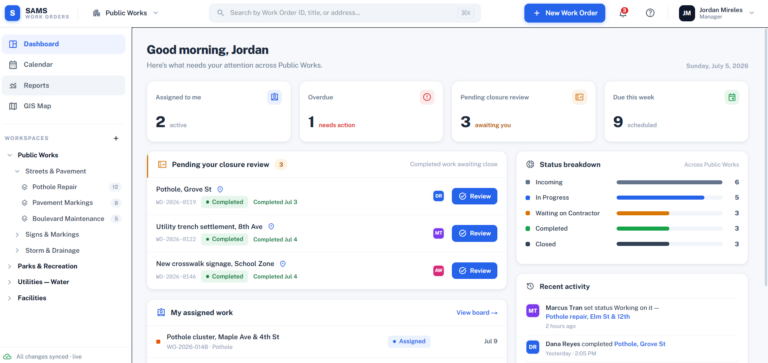
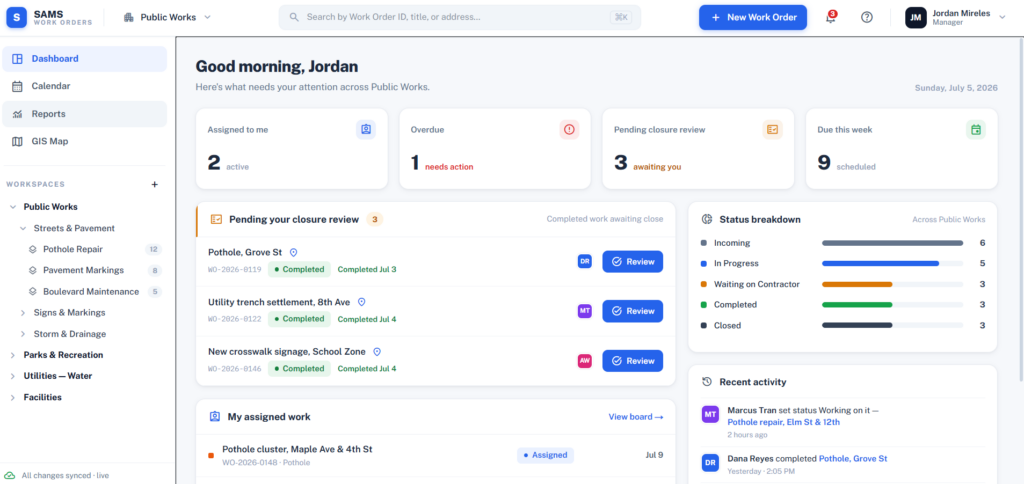
SAMS was designed as an Enterprise Asset Management platform where planning and execution work together.
Within SAMS:
- Assets are linked directly to work orders.
- GIS maps display work order locations.
- Inspection data generates maintenance recommendations.
- Planned projects become work orders.
- Completed work automatically updates asset history.
- Future pavement analyses use the latest maintenance records.
- Dashboards provide real time operational visibility.
The result is a connected workflow that eliminates duplicate data entry and provides a complete history of every public asset.
The Future of Infrastructure Management
The future is not separate systems connected by spreadsheets or manual imports.
It is a unified platform where:
- Inventories
- Inspections
- GIS
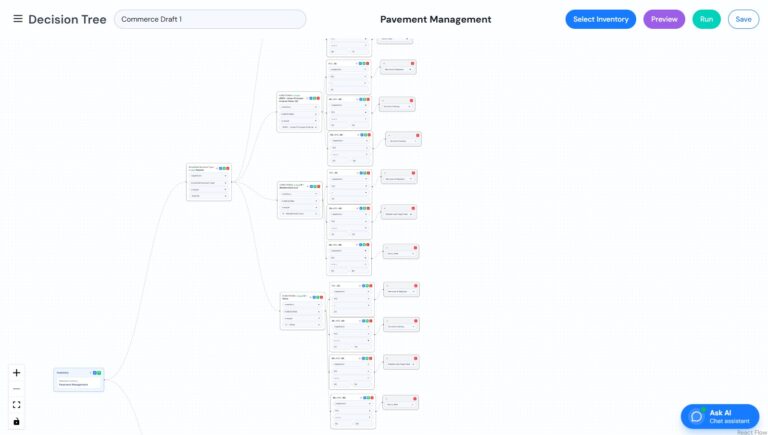
- Pavement management
- Decision trees
- Budget planning
- Work orders
- Mobile applications
- Artificial intelligence
- Predictive analytics
all work together.
This integrated approach transforms asset management from a collection of software tools into a single decision support ecosystem.
Conclusion
Pavement Management determines what should be done.
Work Order Management ensures it gets done.
When these systems are disconnected, agencies lose efficiency, duplicate effort, and weaken the quality of future engineering decisions.
When they are integrated, maintenance becomes a continuous, data driven lifecycle where every inspection informs a plan, every plan becomes a work order, every completed work order updates the asset, and every updated asset improves the next decision.
The future of public infrastructure management is not about having more software.
It is about connecting planning, execution, and historical knowledge into one intelligent platform.
That is the vision of modern Enterprise Asset Management.
About Civil Infrastructure Solutions (CIS)
Civil Infrastructure Solutions (CIS) develops SAMS, a GIS centric Enterprise Asset Management platform that unifies pavement management, asset inventories, inspections, work order management, decision trees, optimization, mobile field operations, and analytics into a single, intuitive solution for public agencies.